How to Say Excuse Me in Korean: 7 Phrases, and Which Job Each One Does
Working out how to say excuse me in Korean is harder than it should be, and the reason is not politeness levels. It is that English uses one phrase for four completely different jobs.
When you say "excuse me" you might be calling a waiter, squeezing past someone on the subway, interrupting a stranger to ask a question, or apologising for bumping into them. English lets tone of voice sort that out. Korean uses a different phrase for each one, and picking the wrong one is what makes people look at you strangely.
Below are seven phrases, sorted by the job they do. Each one says who you can use it on, and - more useful - who you cannot.
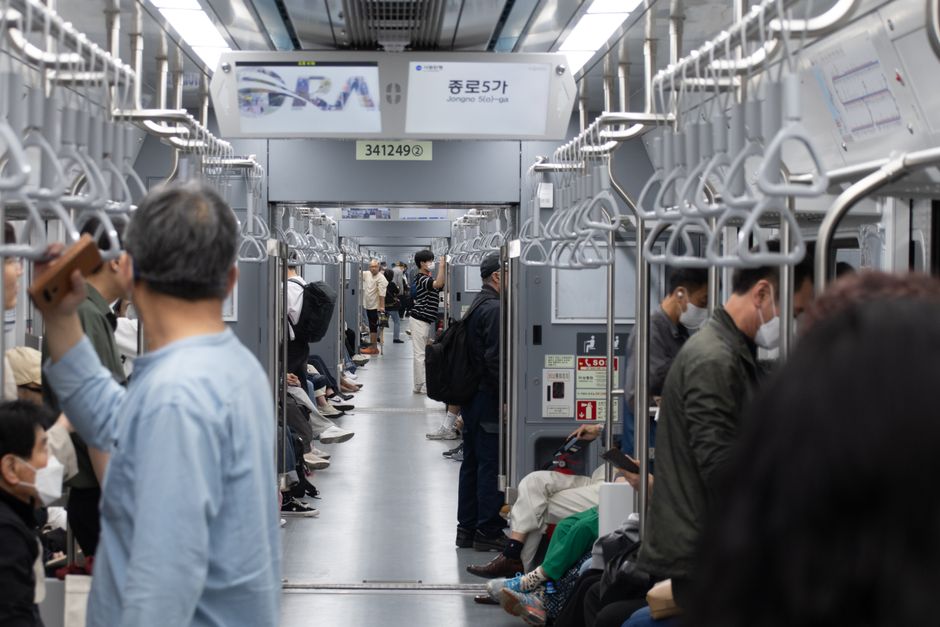
| Situation | Getting someone's attention, passing through, interrupting, or apologising for a small collision |
|---|---|
| How much politeness matters | Medium - the phrase is chosen by function first and politeness second, which is the opposite of most Korean situations |
| Safe default | 저기요 (jeogiyo) for staff, 잠시만요 (jamsimanyo) for getting past - between them they cover most days |
If You Only Remember One
There is no single answer, so learn two.
저기요 (jeogiyo) calls a waiter, a shop assistant, or a stranger whose attention you need.
잠시만요 (jamsimanyo) gets you past someone in a crowd.
If you have to interrupt someone senior or ask a stranger a real question, use 실례합니다 (sillyehamnida) instead of either.
The Expressions, and Who Each One Is For
Jump to a phrase
- 저기요 — jeogiyo (literally: over there)
- 여기요 — yeogiyo (literally: over here)
- 잠시만요 — jamsimanyo (literally: just a moment, please)
- 잠깐만요 — jamkkanmanyo (literally: just a short moment)
- 실례합니다 — sillyehamnida (literally: I am committing a discourtesy)
- 죄송합니다 — joesonghamnida (literally: I am at fault)
- 지나갈게요 — jinagalgeyo (literally: I'm going to pass through)
1. 저기요
jeogiyo (literally: over there)
The everyday way to get someone's attention - a waiter, a cashier, a stranger who dropped something. In a restaurant this is what everyone actually says, often called across the room.
It is polite enough for daily life without being formal. If you learn one attention-getting phrase, learn this one.
⚠️ Watch out — Do not use it on someone clearly older than you outside a service context, and never on a teacher, a boss, or your partner's parents. Calling an elder with 저기요 lands somewhere between blunt and dismissive - use 실례합니다 for them.
2. 여기요
yeogiyo (literally: over here)
Functionally the same as 저기요 for calling staff, with the emphasis on your table rather than on them. You will hear both in restaurants and neither is wrong.
Some people find 여기요 slightly softer because you are pointing at yourself instead of at the other person.
⚠️ Watch out — It is service-context only. Using 여기요 to get a stranger's attention on the street does not really work - they will not know you mean them.
3. 잠시만요
jamsimanyo (literally: just a moment, please)
This is the one for physical space. Say it when you need to get past someone on the subway, squeeze down a narrow aisle, or reach past a stranger for something on a shelf.
It also works to pause someone mid-sentence when you need a second - on the phone, at a counter.
⚠️ Watch out — It does not mean "sorry". If you have already stepped on someone's foot, 잠시만요 will sound like you intend to do it again - switch to 죄송합니다.
4. 잠깐만요
jamkkanmanyo (literally: just a short moment)
The same job as 잠시만요, marginally more casual and more common in speech between people who are relaxed with each other.
Between the two, 잠시만요 is the safer default with strangers.
⚠️ Watch out — The clipped forms 잠깐 and 잠시만 drop the polite ending. Those are for close friends and for people younger than you - not for the person blocking the subway door.
5. 실례합니다
sillyehamnida (literally: I am committing a discourtesy)
The formal one. Use it when you are interrupting someone properly: stopping a stranger to ask a question, entering an office, approaching someone senior, or beginning a request that will take more than a second.
This is the phrase for your partner's parents, your professor, and anyone whose day you are genuinely interrupting.
⚠️ Watch out — Do not use it to call a waiter. It is grammatically fine and socially odd - it announces a serious interruption over a bowl of soup, and it marks you instantly as someone reading from a textbook.
6. 죄송합니다
joesonghamnida (literally: I am at fault)
The apology, used as "excuse me" when something has already happened - you bumped someone, blocked the aisle, or interrupted at a bad moment.
It is the correct response to a small physical collision with a stranger, and it works with anyone of any age.
⚠️ Watch out — Because it admits fault, it is not for getting attention. Saying 죄송합니다 to call a waiter suggests you have done something wrong to them.
7. 지나갈게요
jinagalgeyo (literally: I'm going to pass through)
A more explicit version of 잠시만요 for crowds - you are telling the person what you are about to do rather than asking for a moment.
Useful when 잠시만요 has not registered, which in a packed subway car happens often.
⚠️ Watch out — It is a statement of intent, so it can sound pushy if the person has nowhere to move. Lead with 잠시만요 and keep this one for when that gets no reaction.
 ## How It Sounds in Real Life
In a restaurant, calling a server you have never met
You: 저기요! (jeogiyo!) — Excuse me! Server: 네, 잠시만요 (ne, jamsimanyo) — Yes, one moment.
On a packed subway, getting to the door
You: 잠시만요 (jamsimanyo) — Excuse me, just a moment. Passenger: (moves aside) You: 감사합니다 (gamsahamnida) — Thank you.
Stopping a stranger on the street to ask a question
You: 실례합니다, 길 좀 여쭤봐도 될까요? (sillyehamnida, gil jom yeojjwobwado doelkkayo?) — Excuse me, may I ask for directions? Stranger: 네, 말씀하세요 (ne, malsseumhaseyo) — Yes, go ahead.
You bump someone's shoulder coming out of a lift
You: 아, 죄송합니다 (a, joesonghamnida) — Ah, I'm sorry. Other person: 괜찮아요 (gwaenchanayo) — It's fine.
Which One Do I Pick?
- Decide by function first: calling someone (저기요), moving past (잠시만요), interrupting properly (실례합니다), apologising for something already done (죄송합니다).
- In any restaurant, cafe or shop, 저기요 or 여기요 is the standard call and nobody will think it rude.
- If the person is older than you and you are not in a service situation, upgrade to 실례합니다 regardless of how small your question is.
- In a crowd, say 잠시만요 before you start moving, not while you are already pushing - it is the announcement that makes it polite.
- If contact has already happened, always switch to 죄송합니다. Fault outranks function.
Mistakes That Give You Away
- Do not call a waiter with 실례합니다 - it is the textbook translation of "excuse me" and the wrong tool for the job. Use 저기요.
- Do not use 저기요 on an elder, a teacher, or a boss outside a service context. It is not offensive, but it is noticeably too flat for the relationship.
- Do not say anything after sneezing. English speakers reflexively say "excuse me"; in Korean there is no equivalent and adding one draws attention to it.
- Do not use 잠시만요 as an apology after you have already bumped into someone - it reads as a warning about what you are about to do, not regret for what you did.
- Do not use 미안해 or 미안해요 with strangers. They are the casual apology forms and belong with friends and people younger than you.
- Do not translate "Excuse me?" meaning "what did you say?" with any of these. That one is 네? (ne?) or 다시 말씀해 주시겠어요? (dasi malsseumhae jusigesseoyo?).

What Learners Get Wrong
"저기요 is rude, so I should always use 실례합니다."
저기요 is the normal, expected way to call service staff and it carries a polite ending. What makes it wrong is not rudeness but context - it is too flat for an elder outside a shop, and 실례합니다 is too heavy for a waiter.
"Excuse me is one phrase, so Korean must have one main translation."
Korean splits it by what you are doing, not by how polite you are being. Four English uses map to four different Korean verbs, which is why a single-word phrasebook entry sets you up to fail.
"If I sound polite enough, any of these will work."
Tone does not repair a function mismatch. 죄송합니다 said warmly to a waiter still means you think you have wronged them, and they will ask what happened.
Why Korean Has So Many Ways to Say This
English handles "excuse me" the way it handles a lot of social friction - with one phrase and a lot of intonation. Rising pitch calls a waiter, falling pitch apologises, clipped delivery gets you past someone on a train. The word carries almost no meaning on its own; the melody does the work.
Korean does not distribute meaning that way. The verb has to commit. 실례하다 means to commit a discourtesy, 지나가다 means to pass through, 죄송하다 means to be at fault, and 저기 is literally a place you are pointing at. Each phrase names the actual thing happening, which is why you cannot borrow one for another job no matter how politely you say it.
That is the pattern worth taking away, because it repeats far beyond this page. When an English phrase feels like it should have one Korean translation and instead has five, the split is almost always by function, not by formality. Ask yourself what you are physically doing - calling, moving, interrupting, apologising - and the choice usually makes itself.
What You Will Need Next
- how to say sorry in korean
- how to ask for directions in korean
- how to call a waiter in a korean restaurant
Stop looking for the Korean word for "excuse me" and start asking what you actually want it to do. 저기요 to call, 잠시만요 to pass, 실례합니다 to interrupt, 죄송합니다 when it has already happened. Those four cover almost every situation you will meet, and getting the function right matters more than getting the politeness perfect.


댓글
댓글 쓰기